
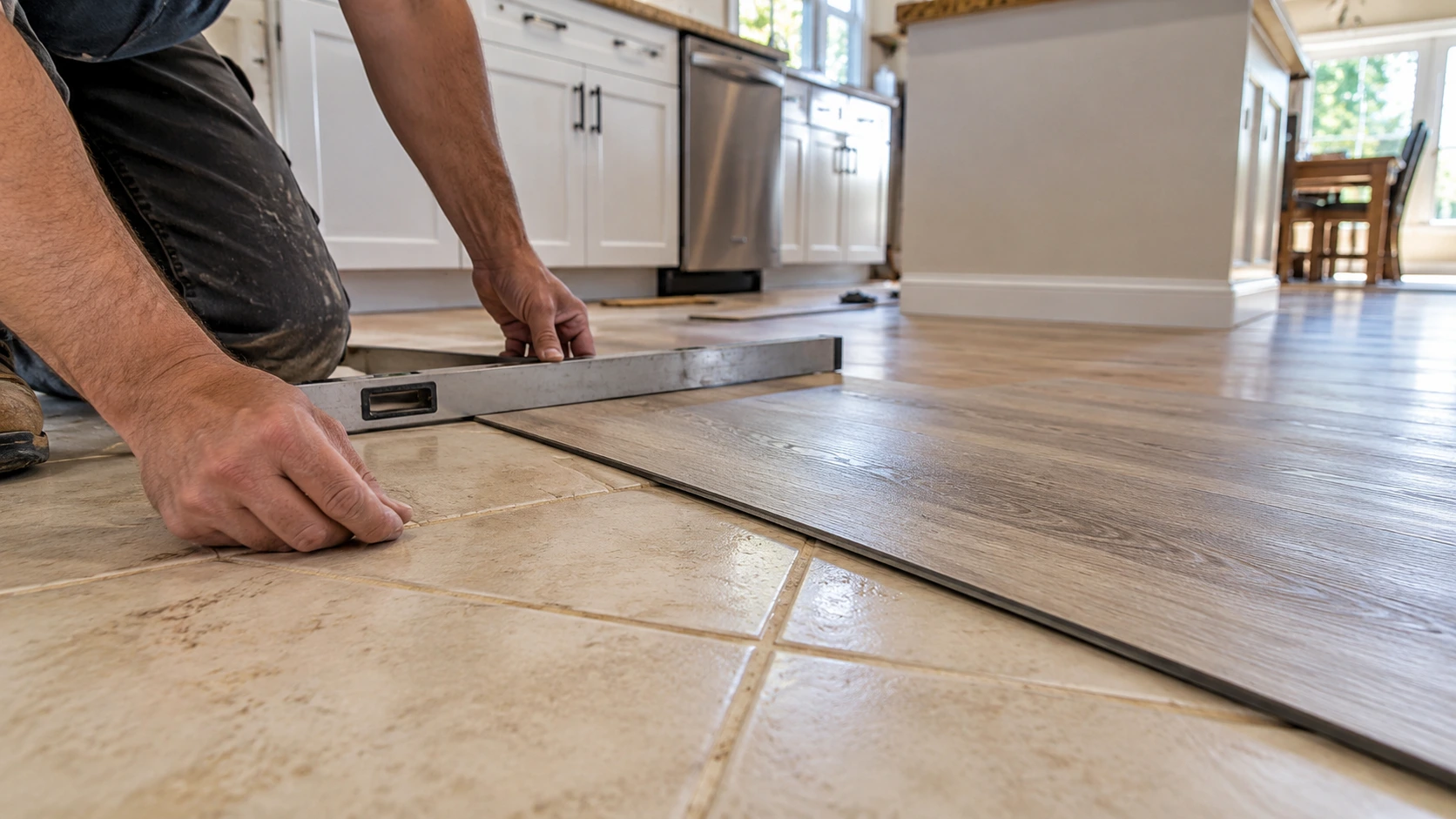
Your existing tile may look outdated, but you don’t always need to remove it to give your room a fresh look. Installing vinyl plank flooring over tile may allow you to update your space without the dust, disruption, and expense of removing the old flooring. However, the condition of the tile underneath will still affect how well your new floor performs.
In many homes, vinyl plank flooring can be installed over ceramic or porcelain tile. However, not every tile floor is suitable for this type of installation. Factors such as the tile’s condition, grout depth, surface flatness, added floor height, and the manufacturer’s installation requirements all need to be considered.
When Can Existing Tile Stay in Place?
The best candidate for vinyl plank flooring is an existing tile floor that is firmly attached, structurally sound, clean, dry, and sufficiently flat to meet the manufacturer’s installation requirements. Even if the tile looks outdated, it can still serve as a suitable base as long as it’s in good condition and free from underlying problems.
Walk across the room and look closely at the grout and tile edges. Cracked, loose, or shifting tiles should be inspected before purchasing new vinyl planks. A few damaged tiles may be repairable, but widespread looseness can make removal the more sensible choice.
Shaw Floors notes that luxury vinyl can often be installed over existing flooring when the surface is flat, clean, and in good condition. However, this doesn’t mean every existing tile floor is suitable for vinyl plank installation.
Why Grout Lines and Uneven Tile Matter
Grout lines are easy to overlook when preparing an existing tile floor. Deep or wide grout lines can create an uneven surface beneath the vinyl planks. Depending on the flooring product and installation method, these gaps may eventually become visible through the new flooring or affect how well the planks are supported.
The appropriate solution depends on the condition of the existing tile and the vinyl flooring being installed. Some manufacturers permit installation over tile only when grout joints fall within a stated limit; others call for an approved patching or smoothing material. MSI’s guidance for Everlife rigid-core flooring, for example, allows installation over ceramic or porcelain tile with grout lines less than 1/16 inch; deeper joints require approved preparation. That figure should not be treated as a universal rule for every vinyl plank.
A tile floor may look even at first glance but still have raised corners, shallow dips, or uneven areas between rooms. The installer should check flatness against the exact product specification and correct irregularities using compatible materials. Adding a soft underlayment without manufacturer approval is not a substitute for fixing an unsuitable surface.
Check Floor Height Before Choosing an Overlay
Vinyl planks may be thin, but installing them over existing tile adds height, especially when additional surface preparation is needed. That added height can change whether a door swings freely, a dishwasher can be removed for service, or a threshold meets the adjoining room cleanly.
Consider how the new floor height will affect nearby rooms and connecting areas. A small step up at a hallway, patio door, or kitchen entrance may be more noticeable in daily life than it seems during planning. Baseboards, door casings, appliance clearance, and the manufacturer’s transition requirements all deserve attention.
Sometimes those adjustments are straightforward. In other homes, removing the tile produces a better finished result than building another layer on top of it.
What About Moisture Beneath the Tile?
Even if the tile looks dry, moisture problems may still exist beneath the surface. That matters particularly where tile sits over a concrete slab or where past leaks have affected the room. Vinyl’s resistance to surface spills does not eliminate the need to assess moisture conditions below the new flooring.
Before covering the tile, identify and resolve active leaks or unexplained dampness. Where the selected system requires moisture testing or a particular barrier, follow its written instructions rather than assuming all waterproof vinyl products have the same installation rules.
Click-Lock and Glue-Down Vinyl Need Different Preparation
A floating click-lock floor and a glue-down vinyl floor do not necessarily have identical requirements. Click-lock vinyl planks connect to each other and are installed over a properly prepared surface. Glue-down vinyl, on the other hand, uses adhesive to attach the flooring directly to the surface underneath.
Glossy tile, residues, grout depressions, and incompatible patching materials can complicate an adhesive installation. Even with a floating system, the tile must satisfy the manufacturer’s flatness and support requirements. The correct approach is to choose the vinyl product first, then prepare the existing tile for that system rather than treating every plank as interchangeable.
Do not assume that extra padding will make a rough tile floor acceptable. Some planks have attached backing, and an additional underlayment may be prohibited or limited by the manufacturer.
When Is Removing the Tile the Better Choice?
Keeping the existing tile may be a good option when it’s in good condition and the added floor height won’t cause problems. Removal becomes a stronger option when the tile is loose across large areas, underlying damage needs repair, the surface cannot reasonably be brought within specification, or the overlay would interfere with doors, appliances, or transitions.
It can also make sense to remove tile when the floor’s history is uncertain. Repeated cracking, recurring dampness, or a noticeable change in elevation may point to conditions that deserve examination rather than concealment. Covering those warning signs does not make them disappear.
Installing vinyl over existing tile isn’t always cheaper or faster than removing the old flooring. The amount of preparation required can change the comparison considerably, so a realistic estimate should consider both approaches.
How to Decide Before Installation Begins
Start with the condition of the existing floor, not the color of the new planks. Confirm that the tile is firmly attached, have the surface checked for flatness and grout depth, and ask how the chosen vinyl product handles installation over ceramic or porcelain tile. Then review floor height at doors, cabinets, appliances, and adjoining rooms.
The useful question is not simply, “Can vinyl go over tile?” It is, “Can this specific vinyl floor be installed over this specific tile without compromising the finished result?” Evaluating the existing floor before installation can help prevent costly problems after the new flooring is in place.
Find Out If Your Existing Tile Is Ready for Vinyl Plank Flooring
Not sure whether your current tile can support new vinyl plank flooring? Flooring Pros can help evaluate the existing surface, identify potential installation concerns, and choose a flooring solution that works for your home. With professional guidance, you can make an informed decision about installing over the tile or removing it first.
Explore our vinyl plank flooring options and request a free in-home estimate to take the next step toward your new floors.