
Anyone who has spent a summer in Houston knows what humidity feels like. Step outside in July or August and the air can seem heavy before you’ve made it to the end of the driveway.
Inside the house, air conditioning makes things much more comfortable, but that doesn’t mean moisture stops being a concern. Flooring is especially worth thinking about because different materials respond to humid conditions in very different ways.
Some floors naturally absorb and release moisture. Others resist water on the surface but can still run into trouble if moisture gets underneath. Concrete slabs, subfloors, indoor humidity, plumbing leaks, and even how the flooring was installed can all influence what happens over time.
Understanding the humidity effects on flooring can make it easier to choose a material that suits both your home and Houston’s climate.
Why Humidity Can Affect a Floor That Never Gets Wet
When people think about moisture damage, they often picture a burst pipe, overflowing appliance, or flooded room. Those situations certainly cause problems, but flooring doesn’t always have to come into direct contact with standing water to be affected.
Humidity is moisture in the air. Materials such as wood can absorb some of that moisture and release it again as conditions change. Moisture can also move through a concrete slab or become trapped between the finished flooring and the surface underneath it.
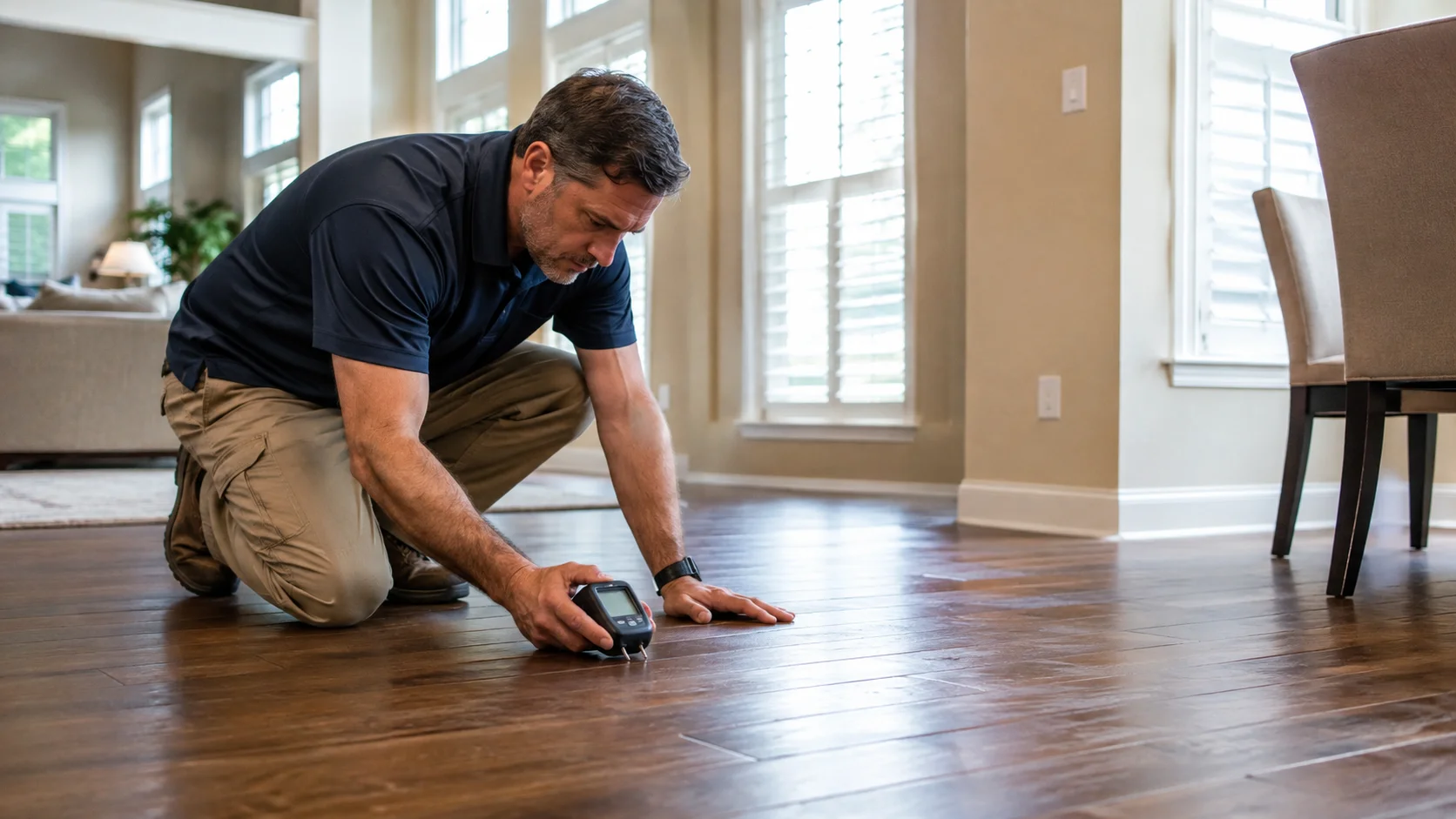
This is why flooring moisture damage isn’t always immediately obvious. A floor may begin to change at the seams, develop raised areas, or feel different underfoot before a homeowner realizes moisture is involved.
Houston homes also spend much of the year moving between two very different environments: hot, humid conditions outside and cooled, conditioned air indoors. Flooring that can comfortably handle those conditions, along with proper installation and moisture control, has an advantage.
Hardwood Responds Naturally to Changes in Moisture
Real wood has character partly because it is a natural material. That also means it reacts to its surroundings.
To understand how humidity affects hardwood floors, it helps to think of wood as a material that continually adjusts to the moisture around it. When it takes on moisture, it can expand. When it loses moisture, it can contract.
A small amount of seasonal movement isn’t necessarily unusual. Problems can develop when moisture levels become excessive or change significantly. Boards may begin cupping, with their edges sitting higher than their centers. Gaps can appear during unusually dry conditions. In more serious moisture situations, flooring can lift or buckle.
None of this means hardwood should be ruled out for a Houston home.
The specific product makes a difference. Engineered hardwood is constructed in layers and is generally more dimensionally stable than solid hardwood, making it an option worth considering in humid climates. Even then, the subfloor needs to be properly evaluated and the manufacturer’s installation requirements followed.
Acclimation may also be necessary depending on the flooring product. Rather than assuming every hardwood floor needs to sit inside a home for the same number of days, installers should follow the manufacturer’s requirements for that particular material.
Laminate Can Handle Everyday Life, but Moisture Still Matters
Modern laminate offers far more choices than it once did, including products designed to provide better resistance to spills and everyday moisture.
The important detail is what lies beneath the decorative surface.
Many laminate products contain a wood-based core. If enough moisture works its way into that core through joints, edges, or damaged areas, the material may swell. Once substantial swelling occurs, those boards aren’t likely to simply flatten out again when they dry.
This can leave seams that look raised or sections of flooring that no longer sit evenly.
Water resistance also varies from one laminate product to another. Homeowners comparing options for a humid climate should look beyond appearance and check the actual specifications of the product they’re considering.
Vinyl Plank Is Highly Moisture-Resistant, but the Subfloor Still Counts
Luxury vinyl plank has become an appealing option for homes where moisture is a concern. Unlike natural hardwood, vinyl doesn’t absorb humidity and expand in the same way, and many modern vinyl flooring products are waterproof.
That can make LVP particularly practical in kitchens, entryways, busy family spaces, and rooms where wet shoes or occasional spills are part of everyday life.
There is an important distinction, however.
A waterproof plank does not automatically make everything underneath it waterproof.
If excessive moisture is coming through a concrete slab, for example, it can remain beneath the finished flooring. Depending on the flooring system, that moisture may affect adhesives, underlayments, or other surrounding materials.
This is one reason moisture testing and subfloor preparation still matter even when the flooring itself is marketed as waterproof.
Tile Is Well Suited to Humid and Wet Areas
Ceramic and porcelain tile are among the flooring materials least bothered by humid air. They don’t expand and contract in response to humidity the way wood-based flooring can, and they handle routine surface moisture very well.
That helps explain why tile remains such a common choice for bathrooms, kitchens, laundry areas, and entryways.
The tile itself isn’t the entire floor system, though.
Grout, setting materials, the substrate beneath the tile, and any required waterproofing all have jobs to do. This becomes particularly important in bathrooms and other areas where the concern isn’t simply humid air but frequent exposure to water.
A durable surface is valuable, but proper preparation underneath it is what helps the entire installation perform as intended.
Carpet Has a Different Relationship With Humidity
Carpet doesn’t cup like hardwood or swell at the seams like some laminate products. Moisture concerns with carpet tend to be less visible.
If carpet, padding, or the subfloor underneath stays damp, the area may begin developing a musty smell. Persistent moisture can also create conditions where mold or mildew becomes a concern.
This is particularly important after a leak. A carpet may feel dry on top while its padding still holds moisture underneath.
Normal household humidity can usually be managed with air conditioning, ventilation, and appropriate indoor humidity control. But rooms that repeatedly feel damp deserve attention rather than simply being dismissed as a normal part of Houston weather.
Epoxy Flooring Depends Heavily on What Is Happening Below It
Epoxy flooring is very different from wood, laminate, or carpet. Once installed correctly, it creates a hard, seamless surface that can work particularly well in garages and other demanding spaces.
With epoxy, the condition of the concrete underneath is especially important.
Concrete may look perfectly dry from above while still allowing moisture vapor to move through it. If moisture levels are too high for the coating system being installed, adhesion problems can develop. Bubbling, peeling, or areas where the coating separates from the slab may follow.
Proper preparation and moisture evaluation before applying the coating are therefore just as important as the quality of the finished product.
So, What Is the Best Flooring for Humid Climates?
There isn’t one answer that makes sense for every Houston home.
If moisture resistance is the main priority, porcelain or ceramic tile can be excellent choices. Luxury vinyl plank also performs well where spills and humidity are concerns while giving homeowners a wide range of wood-look designs.
For someone who wants genuine wood, engineered hardwood may offer a useful balance between the natural appearance of hardwood and greater dimensional stability.
But choosing the best flooring for humid climates isn’t simply a matter of ranking materials from best to worst. The room matters just as much.
A primary bedroom doesn’t face the same conditions as a laundry room. A household with children, dogs, or frequent traffic from a swimming pool may need something different from a quieter home. Flooring over a concrete slab can also bring different moisture considerations than flooring installed over a raised wood subfloor.
The better question is often: What flooring makes sense for this particular room, the surface underneath it, and the way this household actually lives?
Good Installation Is Part of Moisture Protection
Even an excellent flooring product can have problems if it is installed over a surface that isn’t ready for it.
Before new flooring goes down, installers may need to evaluate the subfloor and check for moisture. Depending on the material and installation method, other considerations can include expansion space, underlayment, vapor-control products, adhesives, and product-specific acclimation requirements.
Once the flooring is installed, the home itself becomes part of the equation.
Air conditioning and dehumidification can help keep indoor humidity under control during particularly muggy periods. Bathroom and kitchen exhaust fans remove moisture where a great deal of it is generated. Plumbing leaks, condensation, and water intrusion should be addressed quickly instead of being allowed to linger.
A small indoor humidity meter can also be useful. Houston may be humid outside, but what matters to your flooring day after day is the environment inside your home.
Choose Flooring That Works With Your Home and Houston's Climate
A floor has to do more than look good on installation day. The right material should make sense for the room, the subfloor beneath it, the amount of moisture the space is likely to encounter, and the way your household uses it.
If you’re considering flooring installation in The Woodlands, TX or elsewhere in the Houston area, Flooring Pros can help you compare flooring options with those conditions in mind. Their team also provides professional hardwood installation and a free in-home estimate to help you plan the project, measure the space, and determine which flooring makes the most sense for your home.
Houston’s humidity doesn’t have to dictate how your home looks. It simply needs to be part of the decision.