
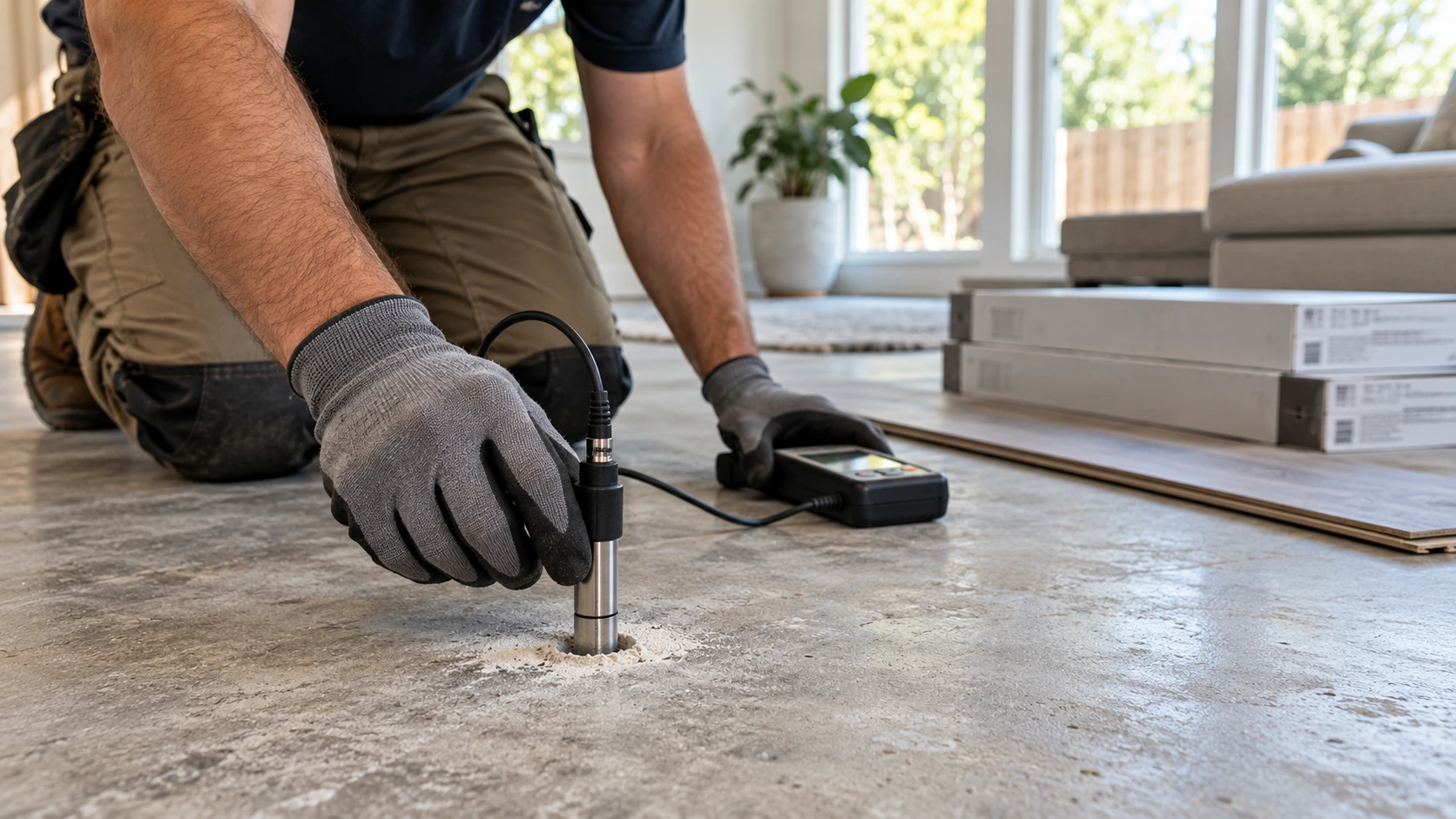
The concrete looks dry, the new vinyl planks are stacked in their boxes, and installation day is getting close. Then someone mentions moisture testing. If there are no damp patches or obvious leaks, it’s reasonable to wonder why another step might be necessary.
A concrete slab can contain moisture even when its surface appears dry. Before installing vinyl plank flooring, the important question is not simply whether the concrete looks ready. It’s whether the substrate meets the specific flooring manufacturer’s installation requirements.
Why Can Dry-Looking Concrete Still Be a Concern?
Concrete holds and exchanges moisture in ways that are not always visible at the surface. A slab may seem clean and dry to the touch while still having moisture conditions that matter beneath a floor covering. That is why a visual inspection alone cannot establish whether a concrete subfloor is suitable for a particular vinyl product.
The risk also depends on the complete flooring system. Adhesives, underlayments, vapor-control products, and the flooring itself can have different requirements. A result that is acceptable for one product or installation method should not automatically be applied to another.
Does Waterproof Vinyl Plank Flooring Make Testing Unnecessary?
Waterproof vinyl is designed to resist water contacting the flooring surface, but that claim does not mean moisture beneath the planks can be ignored. Moisture moving from a concrete slab can affect components of an installation or create conditions the manufacturer does not permit. Even products marketed as waterproof may specify concrete moisture-testing and preparation requirements.
It helps to separate two very different questions: can the plank tolerate an everyday spill, and can the intended installation system be placed over this particular concrete slab? The first is about the product’s surface performance. The second requires following the manufacturer’s instructions for the substrate beneath it.
What Does a Concrete Moisture Test Actually Measure?
Professionals may use different testing methods depending on the flooring system and its written requirements. An in-situ relative humidity test, commonly associated with ASTM F2170, evaluates moisture conditions within the slab using properly installed probes. Some installation instructions also reference other methods, including calcium chloride testing, associated with ASTM F1869.
These methods measure different things and are not interchangeable simply because both produce a number. The installer should follow the product’s current instructions for the approved method, test locations, environmental conditions, and acceptable results. A handheld surface meter can be useful during an initial investigation but is not necessarily a substitute for required formal testing.
When Should Testing Happen Before Installation?
Testing belongs in the preparation stage, not after the planks have been installed. The installer first needs to identify the exact flooring product, its installation method, and the condition of the concrete. Requirements may differ for a newly poured slab, an existing ground-level slab, or concrete in a different setting.
Ask who is responsible for the testing and how the findings will be documented. If the project involves a recent renovation, take time to discuss the slab’s history and any known moisture problems. A single reassuring glance at the concrete is not the same as checking it against the product’s installation criteria.
What If the Concrete Has Too Much Moisture?
An unfavorable test result does not always mean the flooring project must be abandoned. It does mean the installation plan needs to be reconsidered before work proceeds. Depending on the situation, the professional may recommend further investigation, additional drying time, an approved moisture-mitigation system, or a different flooring assembly.
No one solution is right for every slab. A vapor barrier or underlayment should not be assumed to solve the issue unless the chosen materials and installation details expressly support that use. The best path is the one that addresses the observed condition while remaining consistent with the flooring manufacturer’s written requirements.
Five Questions Worth Asking Your Flooring Installer
A clear conversation before installation can prevent confusion later. Ask which moisture-testing method the selected vinyl product requires, who will perform it, and whether the results will be recorded. You can also ask what happens if the slab does not meet the stated limits and whether any additional preparation is included in the estimate.
One more question matters: which exact installation instructions are being followed? Manufacturers revise products and guidance, so the relevant document should match the plank and installation method being used in your home. A knowledgeable installer should be able to explain the decision without reducing it to an unsupported promise that vinyl is waterproof.
Prepare the Concrete Before You Commit to the Floor
A moisture test is not an unnecessary hurdle when the flooring system calls for one. It’s a way to make a more informed installation decision before materials are laid and furniture is moved back into place. The goal is to verify that the concrete is ready for the selected product, not to assume every slab has the same moisture condition.
If you’re planning vinyl plank flooring in The Woodlands or nearby communities, Flooring Pros can help you discuss product selection and installation preparation. Explore our vinyl flooring options, review our vinyl plank installation services, or contact Flooring Pros to talk through your project.