
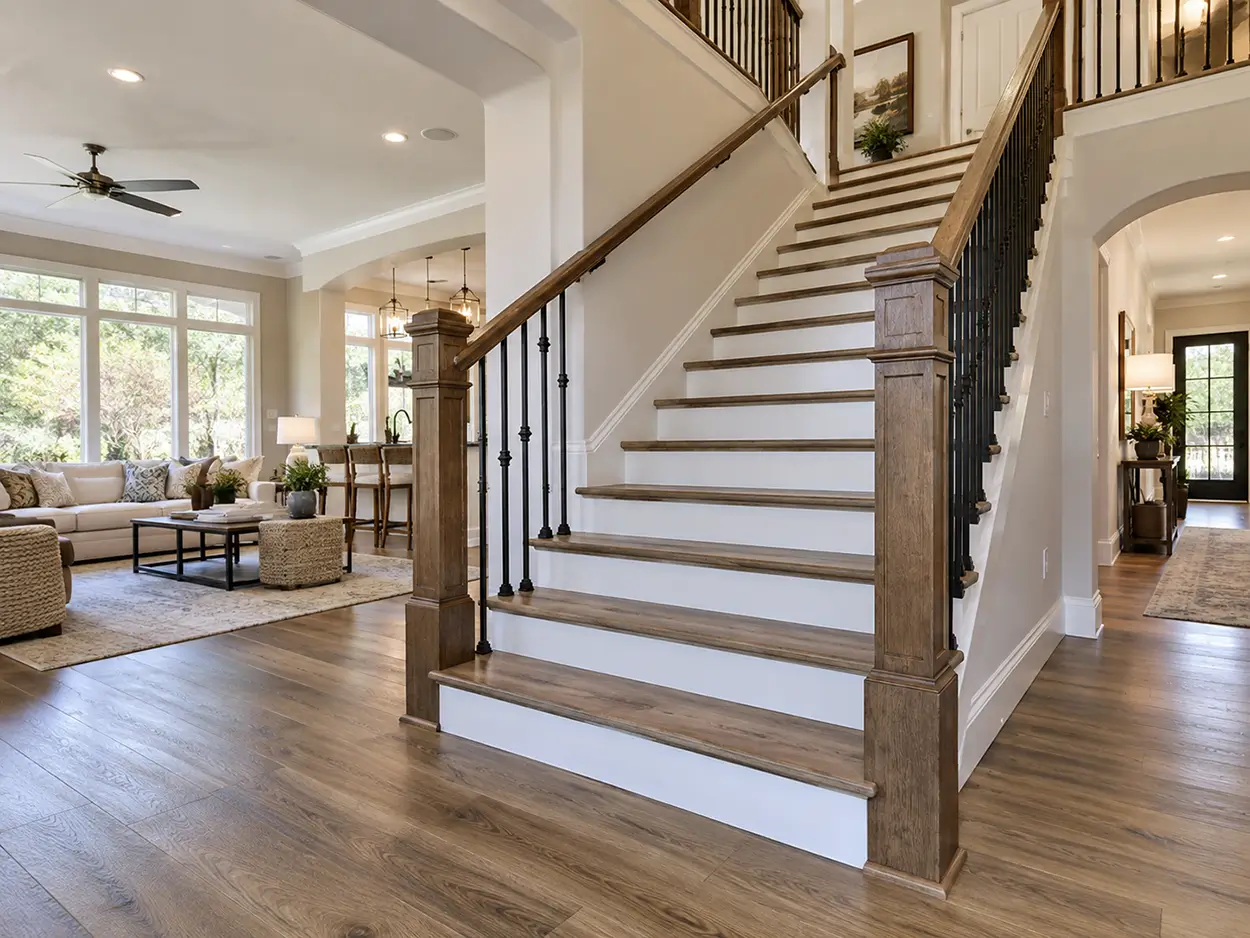
Stairs are a small part of a home’s square footage, but they ask a lot from whatever covers them. Every step concentrates wear into a narrow path, the edge of each tread takes repeated impact, and a surface that feels perfectly comfortable in a hallway can behave very differently when your foot is landing on it at an angle. That is why the best flooring for stairs in The Woodlands should be chosen as a stair material first, not simply as an extension of the floor nearby.
The right answer also changes with the household. A family with young children may care most about a forgiving surface and dependable traction, while another homeowner may want the staircase to read as a piece of finished millwork that connects two hardwood levels. Pets, older family members, noise, cleaning habits, and the shape of the staircase all deserve a place in that decision.
There is no single material that wins every category. A better approach is to decide what the staircase needs to do well, then choose a surface whose strengths actually match that job.
Stairs Ask More From Flooring Than Flat Rooms
A staircase changes the way your foot meets the floor. On a level surface, most of your sole can contact the flooring at once; on stairs, especially during descent, the landing area is smaller and the edge of the tread becomes part of the movement. Peer-reviewed research on stair descent has shown that it places meaningful demands on gait and postural control, particularly for older adults when attention is divided.
That makes traction and edge definition more than design details. U.S. Consumer Product Safety Commission guidance recommends that stair treads be flat, even, in good condition, and slip-resistant; its home-safety checklist specifically points to securely attached slip-resistant surfaces, including dense, low-pile carpeting. Handrails, lighting, and keeping the stairs free of clutter matter too, but flooring is one part of the safety picture you choose at the start.
Carpet Is Hard to Beat for Quiet, Comfortable Stairs
For many households, carpet makes immediate sense on stairs because it softens the surface underfoot and takes some of the sharpness out of footfall noise. The Carpet and Rug Institute notes that carpet absorbs sound and that carpeting on stairs helps dampen the sound of traffic, which can matter quite a bit in a two-story home where the staircase opens toward bedrooms or a main living area. It also gives the stair a warmer, less formal feel than a fully exposed hard surface.
The important word is secure. Stair carpet should sit firmly against the tread and riser without loose edges or worn areas that can create a trip point. CPSC guidance favors dense, low-pile carpeting on stairs, which is a useful reminder that a plush carpet you love in a bedroom is not automatically the best carpet for stairs.
Color and pattern deserve practical thought as well. A subtle pattern can disguise everyday traffic better than a very flat solid color, while a tone that contrasts gently with the riser or surrounding trim can make individual steps easier to read visually. If the staircase is heavily used, I would pay more attention to pile construction, secure installation, and how the carpet will age on the tread edge than to softness alone.
Hardwood Turns the Staircase Into Part of the Architecture
Hardwood gives a staircase a very different character. Instead of visually receding, the stairs can become part of the home’s millwork, especially when the treads coordinate with flooring on the first or second level. It is a strong choice when the goal is a clean, continuous wood look, and it is easier to wipe clean than carpet after everyday dust or pet hair.
A hardwood staircase is not simply a plank floor tilted upward. National Wood Flooring Association installation guidance treats stair treads as dedicated components, including solid treads and overlay treads used over existing subtreads. That distinction matters in remodeling because tread thickness, rise, nosing, fit, and the condition of the underlying stair all affect how the finished staircase comes together.
The tradeoff is that wood is a hard surface. It offers less cushioning if someone falls, and a smooth finish can feel slick in socks or certain footwear. In a home where that gives you pause, hardwood treads paired with a properly secured runner can be an elegant middle ground rather than an admission that one material “lost.”
Vinyl and Laminate Can Work, but the Stair Detail Has to Be Right
Homeowners often ask about vinyl plank on stairs because they want the staircase to match a wood-look floor on the main level. That can be possible, but stairs are one place where product-specific installation instructions really matter. Some flooring systems have matching stair noses or tread components, while others are not intended to be carried onto stairs in the same way they are installed across a room.
The same caution applies to laminate. Manufacturer instructions for some laminate products require stair pieces to be fully adhered rather than installed as a floating floor, with compatible nosing used at the tread edge. In other words, the fact that a plank works beautifully in a hallway does not tell you by itself how it should be installed on the staircase.
This is where I would resist choosing on appearance alone. A matching color is satisfying, but the finished edge, fastening method, tread geometry, and manufacturer’s approval for stair use matter more than making every horizontal surface in the house look identical. If the proper stair components do not exist for a particular product, that is valuable information before the material is ordered.
A Runner Can Solve More Than One Problem
A runner is worth considering when you love the look of wood stairs but want more softness, traction, or sound control through the walking path. It preserves a visible border of wood on each side, so the staircase still feels architectural rather than fully carpeted. For many homes, that combination feels less like a compromise and more like a deliberate design choice.
Runners also give you more freedom with pattern than a whole room often does. A restrained stripe, texture, or small-scale motif can bring character to a staircase without taking over the rest of the interior, and the fabric can help quiet repeated foot traffic at the same time. The installation still needs to be tight and secure; a beautiful runner with movement at the tread edge is not a good trade.
Think About the Floors Above and Below
One of the easiest ways to make a staircase feel disconnected is to choose its surface in isolation. The stairs are a transition between two levels, so they need to make visual sense from both directions. If hardwood is downstairs and carpet is upstairs, for example, the staircase can lean toward either material or intentionally bridge the two with wood treads and a runner.
The answer is not always to match the floor you see first. Pay attention to where the staircase begins, what you see when standing at the bottom, and what happens at the upper landing. A material change that lands naturally at a threshold or landing will usually feel more resolved than one that seems to stop halfway through the home’s design language.
What I Would Prioritize in a The Woodlands Home
If safety, quiet, and comfort are the biggest concerns, I would start by looking at a well-constructed, dense low-pile carpet installed specifically for stair use. If the staircase is a major visual feature and you want a more permanent architectural look, properly built hardwood treads deserve serious consideration. For homeowners who want the stairs to continue an existing vinyl or laminate floor, I would confirm the exact stair system, nosing, and installation method before falling in love with the color.
Household habits should break the tie. Think about whether family members often use the stairs in socks, whether a dog races up and down them, how much sound travels between floors, and how comfortable you are maintaining carpet versus a hard surface. Those details are less glamorous than choosing a stain color, but they are the details you will notice every day.
The best flooring material for stairs is the one that suits the actual staircase and the people using it. That may be carpet, hardwood, a stair-rated resilient system, or a combination such as wood plus a runner. A good stair decision should feel natural underfoot, look intentional from both levels, and still make sense after the novelty of the renovation has worn off.
Choosing Stair Flooring With Flooring Pros
If you’re comparing stair flooring options in The Woodlands, Flooring Pros can help you look beyond the sample board and think through how the staircase will actually be used. Their team can measure the space, evaluate the transitions at the upper and lower levels, and help you compare materials during a free in-home consultation so the finished stairs work with the rest of the home rather than feeling like a separate project.
Homeowners considering a softer stair surface can explore carpet options, while those drawn to a more architectural look can review hardwood flooring choices with the same attention to tread construction and installation details. The goal is not simply to cover the steps. It is to choose a stair surface that feels secure, looks considered, and belongs in the home for the long haul.